
Why Is Keyword Research Important?

Don’t just take our word for it. Browse one of our content writing case studies and see what we could be doing for you. We’ve worked across many sectors with businesses and charities of all sizes. We have experience that will benefit you.
How To Do Keyword Research?
Before we get to the volume and competitor metrics available in the Google AdWords Keyword Planner, there are three other important sources of keywords to investigate:
Google Analytics
After coming up with your initial list you should then use your Google Search Console reports to see which keywords your website is already getting found for. Again, you’ll be surprised by a few and inspired to research in other directions as well.
Google Search
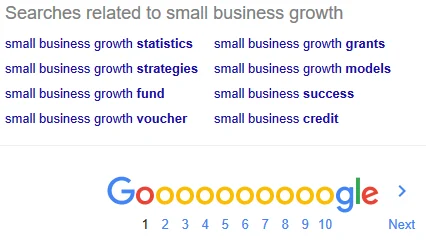
Next, head to Google and do a search for one of your keyword terms. Scroll to the bottom of the page to see ‘related searches’. You may want to add these terms to your list.
Google Ads Keyword Planner
Keyword Planner is Google’s own free tool. It was originally designed to help find relevant keywords for PPC (Pay Per Click or adwords) campaigns. The tool however is also useful to analyse the keywords you have on your list of potential terms and phrases to target.
Google Ads Keyword Planner makes a lot of historical traffic volume data available. You can use this to eliminate words from your list that have very few people actually searching for them. It can also forecast how search volumes will change over time allowing you to get in early on an upwards trend.
To use the tool you will need an account (you can sign up here). Navigate to the “Tools & Settings” menu and select “Keyword Planner” under the “Planning” section. Don’t forget to filter your searches to relate to the UK only or the search volumes shown will be much higher. When determining volume for a particular keyword, be sure to set the Match Type to [Exact] and look under Local Monthly Searches. Depending on your eventual ranking and click-through rate, the actual number of visitors you achieve for these keywords will usually be much lower.
Analysing The Results
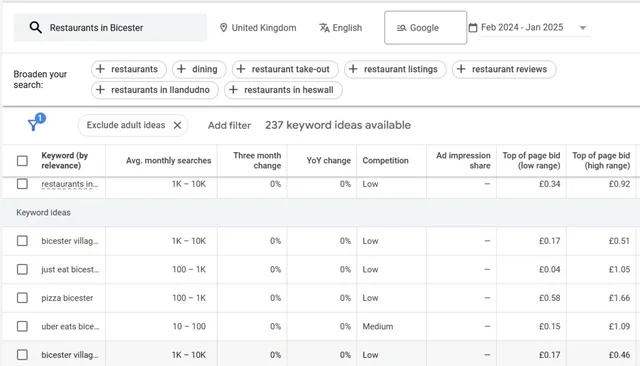
On the Keyword Ideas tab the results will be displayed like this:
Key Features
Keyword Suggestions: Generate lists of related terms pertinent to your business.
Search Volume Estimates: View approximate ranges for monthly searches, aiding in prioritizing target keywords.
Geographic Targeting: Filter keywords by location to ensure relevance to your audience.
Competition Analysis: Assess how competitive a keyword is in Google Ads, providing insight into the difficulty of ranking for specific terms.
Recent Updates
In recent years, Google has enhanced the Keyword Planner with features like 12-month click trend data and improved interface filters. These updates aim to provide more precise and actionable data for users. It’s important to note that while the tool offers valuable insights, the search volume data is often presented in broad ranges, which may require supplementary tools for more granular analysis.
Best Practices
Exact Match Type: When analyzing search volumes, set the match type to “Exact” to obtain data specific to the keyword of interest.
Local Monthly Searches: Focus on local search data, especially if your business targets a specific geographic area.
Trend Analysis: Utilize the trend feature to identify seasonal variations and adjust your strategies accordingly.
By effectively leveraging the Google Ads Keyword Planner, you can identify new keyword opportunities, assess search volume and competition, and develop a robust SEO strategy tailored to your target audience.
Head, Body & Long Tail Keywords
A general rule is that the value is in the long tail. Let me explain.
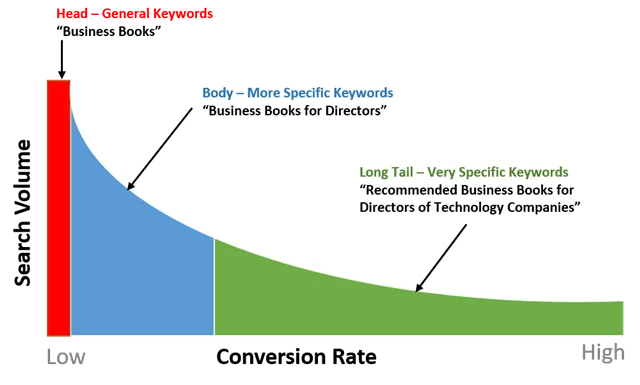
Head keywords are at the most just two words long. They are incredibly hard to rank for and also don’t convert well so they would very rarely be top of our list when deciding what to rank for.
Much more productive are the keywords in the ‘Body’ where there is search volume and buyer intent but also some competition to beat. An added bonus of trying to rank for these search terms is that, with enough well written content that matches the search intent, you can also rank for a lot of closely related long tail keywords as well.
Some phrases in the long tail keywords section are completely new and very difficult to predict indeed. 15% of all long tail searches have never been done before!
Understanding the Long Tail of Keyword Demand
A real world example best illustrates the buying intent of people searching in the long tail.
You might think that it would be great to rank number one on Google for the words, “Business books,” but would it? It’s a vague search that would often be made in an attempt to understand what’s out there, what’s any good and what’s available to buy. A lot of these books are aimed at students and our mythical searcher is a director in his business. What’s more he is the director of a technology company and he wants a book aimed directly at his needs. By the time he searches for “Recommended business books for directors of technology companies” he practically has his wallet out and is ready to buy.
Understanding the search demand curve is critical. Understanding the intent of the people doing the searches is even more important and will be the subject of our next blog.
For help with your keyword research, talk to us now.