How to Write Good Website Content
If you want your website pages or your blog to rank well on Google, gain relevant traffic and convert visitors to paying customers then you have to write good, engaging, authoritative, trustworthy content that demonstrates your expertise and experience in your chosen sector.
What is EEAT?
EEAT is a framework Google uses to assess content quality and rank websites. It stands for Experience, Expertise, Authoritativeness, and Trustworthiness, and prioritises credible, authentic, and relevant content over generic or AI-generated material.
“EEAT is a template for how we rate an individual site. We do it to every single query and every single result. It’s pervasive throughout every single thing we do” Hyung-Jin Kim, VP of Search, Google
EEAT in Action
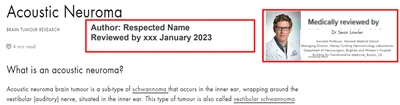
Experience: Unique visuals, personal anecdotes, sensory descriptions.
Expertise: Showcase qualifications, achievements, and credible sources.
Authoritativeness: Comprehensive content, regular updates, and consistent quality.
Trustworthiness: Transparent authorship, user reviews, and accountability.
If you do not invest in your content, then your website will more than likely fail to attract new customers. Whether you write your content yourself or hire a specialist copywriter to help you, there are rules to follow and standards to aim for to be able to outrank your competitors.
Your first step is to benchmark yourself against competitor websites. They’ve set the standard to beat and one of the reasons that they are outranking you is because of their content. Your next step is to write content that is better than them.
Google’s algorithm is getting cleverer by the day. There are steps you can take to give search engines what they want but the golden rule is to write for your user and specifically for what they are looking for. Approach content writing from the point of view of your potential customer or client and give them what they want and you will be ahead of the game.
The eight steps below should help you in your approach and for more detailed advice you should get in touch with us.
Don’t just take our word for it. Browse one of our content writing case studies and see what we could be doing for you. We’ve worked across many sectors with businesses and charities of all sizes. We have experience that will benefit you.
1. Focus On The User – Help Them To Learn Something Based On Their Intent
Optimising for the real people behind the search queries means understanding the intent of their search.
- The user intent lies somewhere beyond the search query of the keywords used. It is the goal of the user which typically falls into three categories: Do something, Know something, or Go somewhere
- Google’s search results are a strong indicator of what people are looking for because they reflect the content people engage with i.e. click through to and spend time on the page
- Understand if your site visitors want a product or service, how-to instructions or general information
- Answer the FAQ’s you encounter in the real world as these will be reflected online
- If your content is relevant and fulfils the user intention, Google will rank it
2. Writing For Your Audience Is The Same As Writing For Google
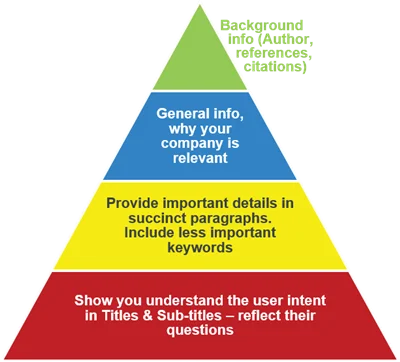 To rank at the top of Google content must be better, more authoritative and more trustworthy than the content currently ranked there. This does not mean writing content aimed at search engines. If your visitors stay on your page for longer than they do a competitor page, search engines are clever enough to understand that this is because you are providing what people want and this can be rewarded with a move up the rankings.
- Google likes content that your visitors like i.e. high quality writing that cover a topic in-depth and keeps visitors on your website
- Most important is whether your content is engaging, relevant and fulfils the user intention. The word count is not decisive for rankings (quality over quantity is a continuing trend in 2019 – fluff will not make the grade)
- You have written enough when your visitors intent is met
- 100 words is often to short to meet user intent although it may be enough to answer a specific question within a topic. Ten 100 word well formatted paragraphs with clear titles is far better than a 1,000 word block of text
- Visitors are hungry for knowledge and want content that is satisfying to EEAT (Expertise, Experience, Authoritativeness and Trustworthiness) – better than whoever is currently at the top of Google
- Demonstrating relevance early keeps visitors engaged and reading your content
- Avoid producing duplicate content across different pages. It’s annoying for the user and Google hates it. Merge old pages into one, fresh page covering the topic area in clear, succinct paragraphs
- Create content that appeals to the specific needs, interests,and problems of the audience you’re targeting
- Demonstrate your experience and expertise to gain trust
- Delete old content that gets few visitors and is not helpful to anyone
3. Creating Scanable Content – Formatting For The Web
 Readers have short attention spans and they scan content for its main takeaways. If content isn’t easy to read and navigate, visitors to a website will leave very quickly.
- Make content easy to scan so people can pick up the important bits quickly
- Break up content with sub-headings, bullet points and numbers, and use bolded text to tell the reader where to focus their attention
- Add images that help and add value
- Structure to benefit from F-shaped reading: www.Nngroup.Com/articles/f-shaped-pattern-reading-web-content.
4. The Pronoun “You” Can Be Very Persuasive
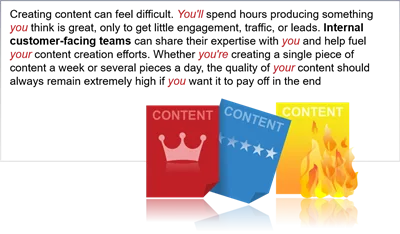
- It invites the reader to engage with your content
- Using the word “you” implies something active – a choice to listen
- People who boast and talk about themselves are not generally popular. People who talk to you about your interests generally are
- Conversely, the more you use “we” words — like us, our and ours — the less interested people are
- Write in an engaging conversational style to connect with your visitors
5. Use A Value Proposition
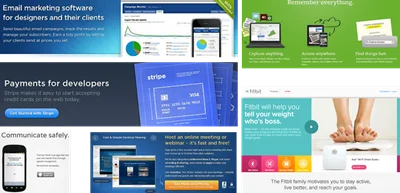 A website needs to tell visitors in a couple of sentences or less why their business is the best choice for the visitor
- The Value Proposition (VP) is the #1 thing that determines whether people will bother reading more or hit the back button
- This is best done graphically as it draws the eye and communicates quickly and effectively
- A value proposition communicates relevance, benefits and answers, “why buy from us”
- A VP should be visible at the top of all landing pages and be unique to each core product
- It will encourage visitors to read more
- It answers: What problem do we solve? What are the benefits?
Value propositions come in many different forms. Use Google images for examples and also look to see what your competitors are doing.
6. Use A Call To Action
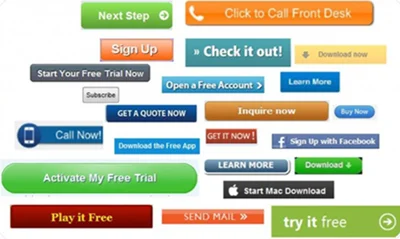 People like to be shown and told what to do next. You can make it easy for them with a call to action button which is an instruction to your audience to provoke an immediate response.
- A CTA can be a bright noticeable button or a text link. The former is most effective
- The purpose of a CTA is to guide your visitor to take the action you want them to take
- Popular CTA’s include an imperative verb such as “Download”, “Subscribe” or “Call Now”
- Placement is important and should be visible at the point where your prospect has become convinced to take action
Presold prospects who already want what you’re offering when they arrive – give prospects a call to action immediately
Uncertain prospects need an offering that is very easy to understand and immediately see the value of. These prospects will only need a small amount of strong, very clear copy to convince them to hit that CTA. Place above the fold* (i.e. before scrolling is required)
New prospects need an offering that requires some explanation to see the value of. These prospects will need a reasonable amount of copy that is not only clear, but also very well written to keep their interest from the headline all the way through to the CTA which should appear at the bottom of the page
Uncertain and new prospects can be targetted twice with two CTA’s used above and below the fold.